
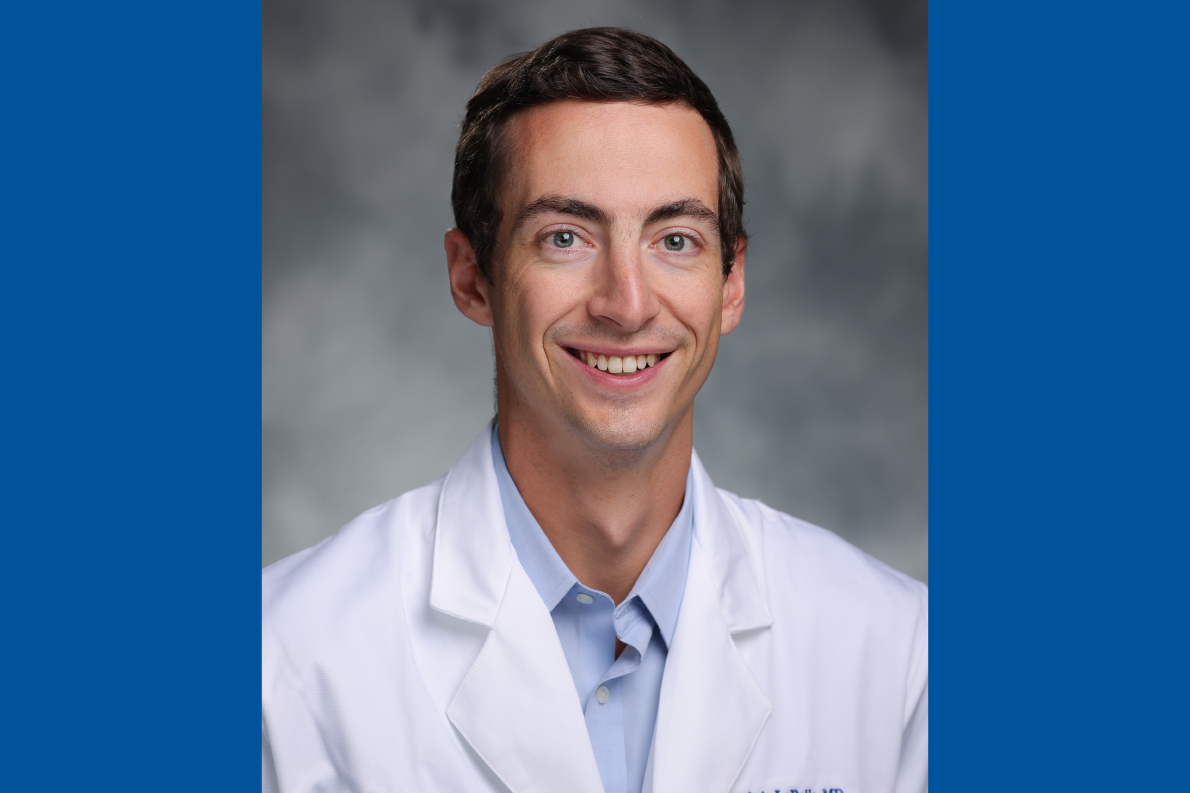
In January, Duke Radiation Oncology resident Dominic LaBella, MD (first author), along with Duke Radiation Oncology faculty Chunhao Wang, PhD; John Kirkpatrick, MD, PhD; Scott Floyd, MD, PhD; Zach Reitman, MD, PhD; Trey Mullikin, MD; and Eugene Vaios, MD, MBA, were among the authors of “The 2024 Brain Tumor Segmentation Challenge Meningioma Radiotherapy (BraTS-MEN-RT) dataset,” published in Scientific Data.
BraTS-MEN-RT is the largest multi-institutional, expert-annotated radiotherapy planning MRI dataset for meningioma ever assembled. It marks a major milestone in advancing automated segmentation tools that are tailored specifically to radiotherapy workflows.
Meningiomas are the most common primary intracranial tumors and frequently require radiotherapy as part of their management. However, defining the gross tumor volume (GTV) – essentially determining where the tumor is in order to treat it – is labor-intensive and requires specialized expertise, particularly in postoperative cases where anatomy can be complex.
Previously, many brain tumor datasets were optimized for convenience. Images were skull-stripped to remove non-brain tissues like skull, fat and skin from scans, and many images were standardized. This made algorithms easier to train but less clinically realistic.
The BraTS-MEN-RT dataset directly addresses this clinical challenge by grounding data in real clinical practice. The dataset keeps MRI scans in their native resolution and orientation; avoids skull-stripping; and preserves extracranial anatomy like headframes or fixation devices used in radiosurgery, ensuring that models trained on this dataset must learn to work with the same clinical complexity that clinicians see in actual radiotherapy planning.
The images reflect thousands of hours of radiotherapy planning from radiation oncologists and other clinicians across institutions. “Transforming those clinical contours into a standardized, research-ready resource required hundreds of additional hours devoted to harmonizing definitions, performing meticulous slice-by-slice review, correcting inconsistencies and ensuring adherence to a shared radiotherapy-focused protocol,” said Dr. LaBella.
BraTS-MEN-RT authors are hopeful that making this dataset freely available will help integrate automated segmentation tools into real-world radiotherapy workflows, ultimately improving the efficiency, consistency and objectivity of meningioma treatment planning. “If we want models that meaningfully assist radiation oncologists,” said Dr. LaBella, “we need resources that capture postoperative complexity, acquisition heterogeneity and real planning context.”
Key features of the dataset include:
- 750 radiotherapy planning MRI exams from seven academic medical centers across the U.S. and United Kingdom – Duke University, University of California San Francisco, SUNY Upstate Medical University, University of Washington, University of Missouri, King’s College London and University of California San Diego
- Of those, there are 570 publicly accessible 3D T1-weighted (an MRI setting that makes certain tissues easier to see) post-contrast MRIs at native resolution
- Of those, 500 cases include expert-annotated GTVs for model development

Read the article Read Dr. LaBella's post on Springer Nature's blog